
AI product discovery vs traditional ecommerce search: What's the real difference?
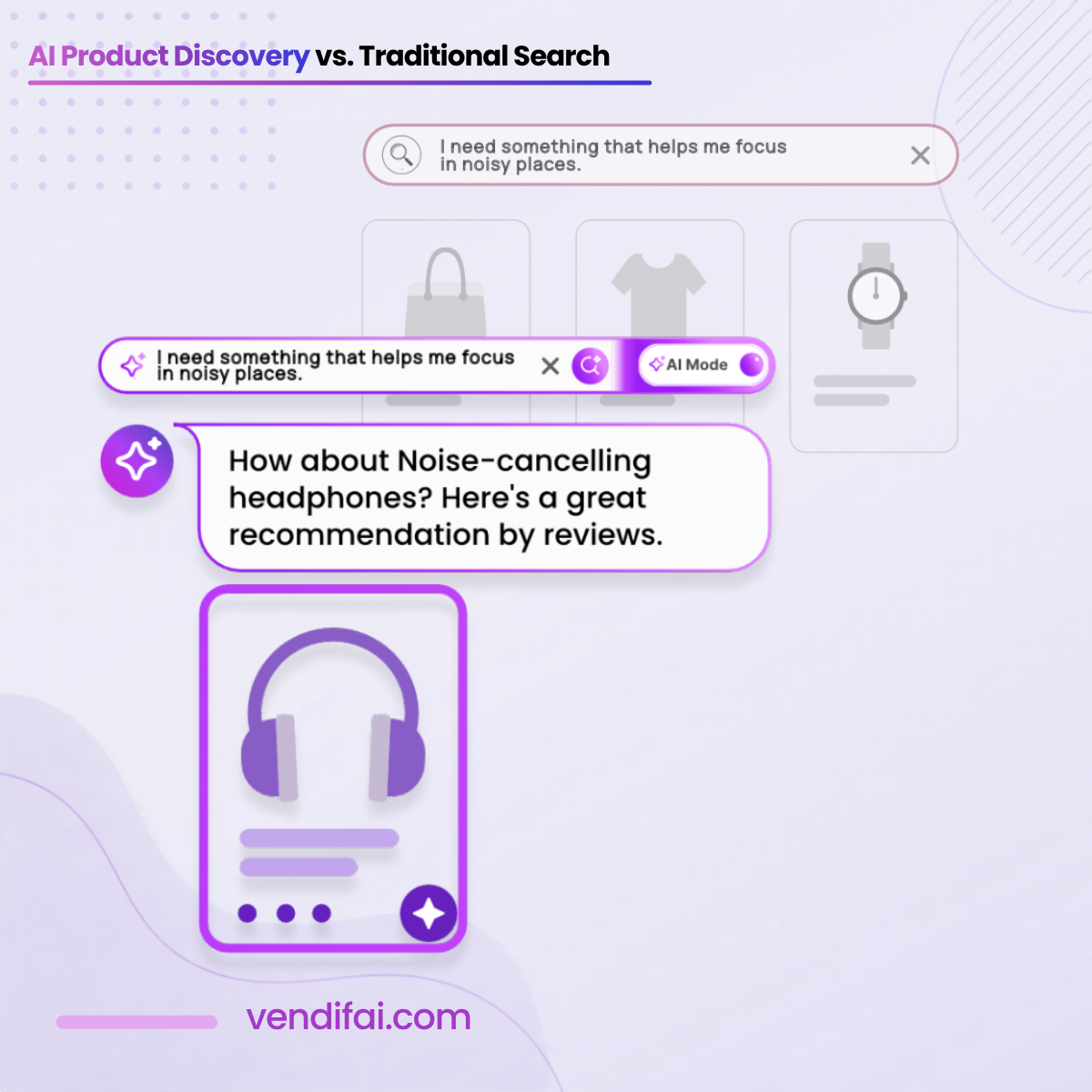
AI product discovery vs traditional ecommerce search: Most ecommerce websites have a search bar. Shoppers use it all the time. Most of the time, it disappoints them. The mismatch between what the customer searched for and what the search engine delivered is the major cause of lost revenue in the ecommerce world, and one that traditional keyword search was designed to address. AI-powered product discovery uses an entirely different approach.
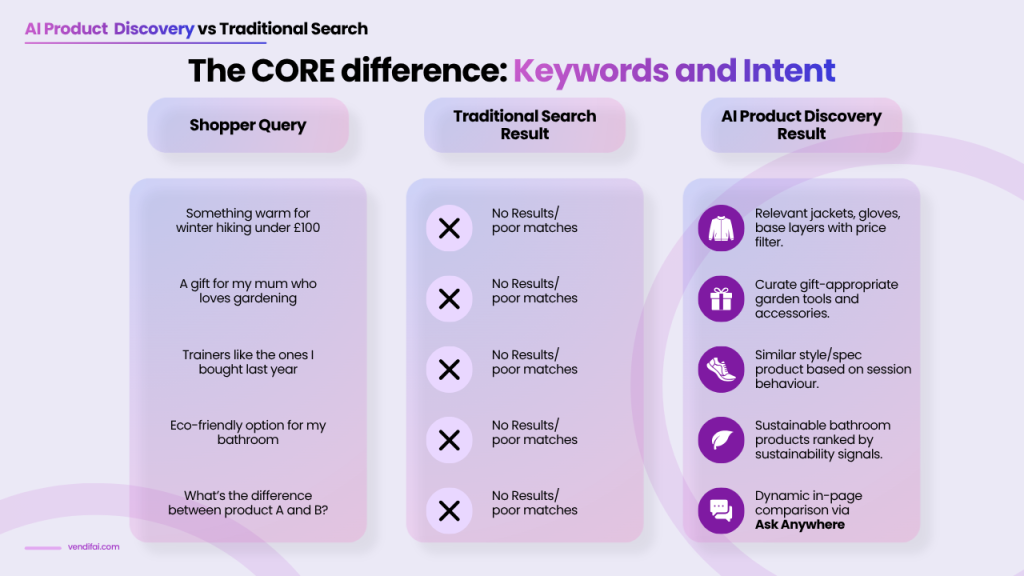
The Core Difference: Keywords vs Intent
Traditional ecommerce search is based on the matching principle: it searches for items that have words entered by the user in their title, description, or tags. Searching for “red sneakers,” it finds items that have a tag for “red sneakers.” When a customer searches for “comfortable shoes for a nurse working 12-hour shifts,” the search delivers no results, or even worse, irrelevant results.
AI product discovery operates on intent. It analyses the meaning of the search query, using natural language processing and semantic search technology for ecommerce. Comfortable shoes for nurses working long shifts will be found in cushioned soles, slip-resistant soles, and correct-fitting shoes. Vocabulary is not important. What matters is intent.
AI product discovery vs traditional ecommerce search
Side-by-Side: How each approach handles real shopper queries
Understanding the gap becomes clearer with real examples:
| Shopper query | Traditional search result | AI product discovery result |
|---|---|---|
| Something warm for winter hiking under £100 | No results / poor matches | Relevant jackets, gloves, base layers with price filter applied |
| A gift for my mum who loves gardening | No results | Curated gift-appropriate garden tools and accessories |
| Trainers like the ones I bought last year | No results | Similar style/spec products based on session behaviour |
| Eco-friendly option for my bathroom | No results or random matches | Sustainable bathroom products ranked by sustainability signals |
| What's the difference between product A and B? | No results | Dynamic in-page comparison via Ask Anywhere |
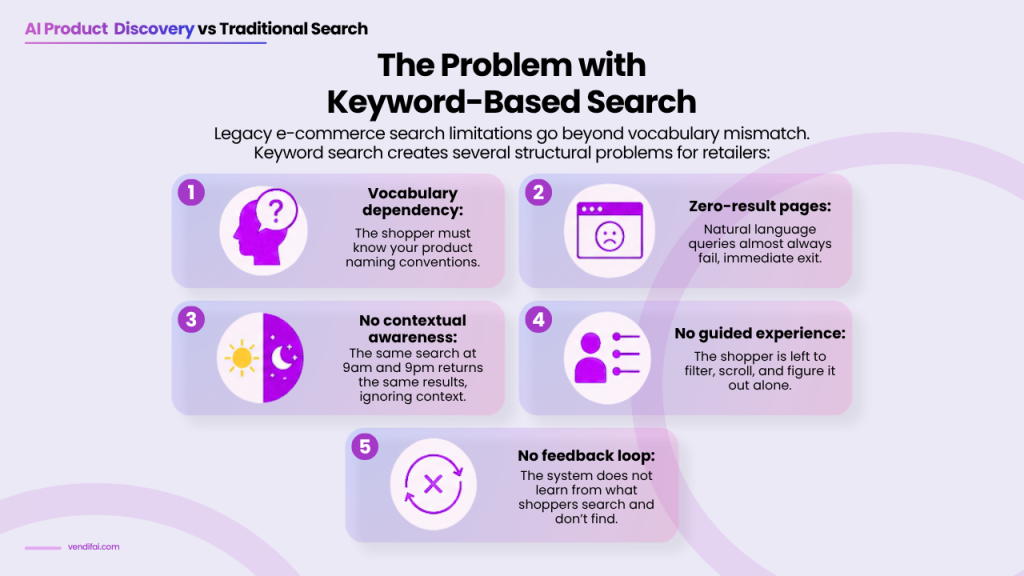
The problem with keyword-based search
Legacy ecommerce search limitations go beyond vocabulary mismatch. Keyword search creates several structural problems for retailers:
- Vocabulary dependency: the shopper must know your product naming conventions.
- Zero-result pages: natural language queries almost always fail, causing immediate exit.
- No contextual awareness: the same search at 9 am and 9 pm returns the same results, ignoring context.
- No guided experience: the shopper is left to filter, scroll, and figure it out alone
- No feedback loop: the system does not learn from what shopper’s search and don’t find.
AI product discovery vs traditional ecommerce search
What vector search adds to the equation
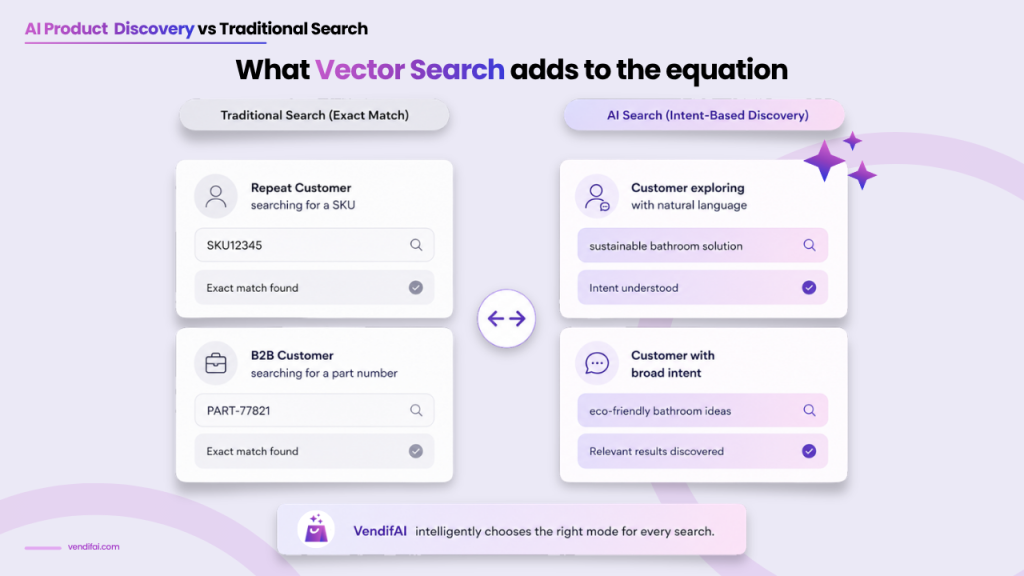
Vector search ecommerce is the underlying technology that makes semantic matching possible. Instead of finding similar text strings, vector search algorithms translate user queries and product descriptions into vectors (mathematical representations), finding the nearest match in terms of meaning rather than wording. That’s why VendifAI allows you to find “sustainable bathroom solution” using “eco-certified bamboo bathroom products” despite no keyword intersections.
VendifAI’s AI Search is a combination of vector search and intent discovery that makes any mismatch between users’ words and their real intents completely obsolete.
AI product discovery vs traditional ecommerce search
When traditional search still has a role
Scenarios where an exact keyword search proves effective include a repeat customer searching for a SKU or a B2B customer searching for a part number. The best platforms incorporate both these features; they will revert to conventional search behavior in case of an exact match, but will use intent-based discovery otherwise. The two modes can co-exist in VendifAI.
The business impact of making the switch
Shifting from keyword search to AI-driven product discovery allows brands to reap four different benefits. These include increased engagement with search results, reduced exit of shoppers due to zero search results, higher conversion rate on search, and finally, purchase intent based on customer feedback captured through the “What Customers Say” functionality of VendifAI.
Frequently Asked Questions (FAQs)
In retail, semantic search recognises the underlying meaning of a shopper’s question rather than matching keywords. With NLP, you receive contextually relevant products even if the wording doesn’t precisely align with product titles.
Not at all. AI product discovery platforms such as VendifAI that meant for use regardless of catalog size. Low bounce rate, higher conversions, and fewer zero-result pages are all advantages that apply to an e-commerce store with search capability.
Not with modern plug-and-play platforms such as VendifAI have been developed to enable semantic search functionality within a single day through a script.