
7 important signs your retail store needs ecommerce product discovery
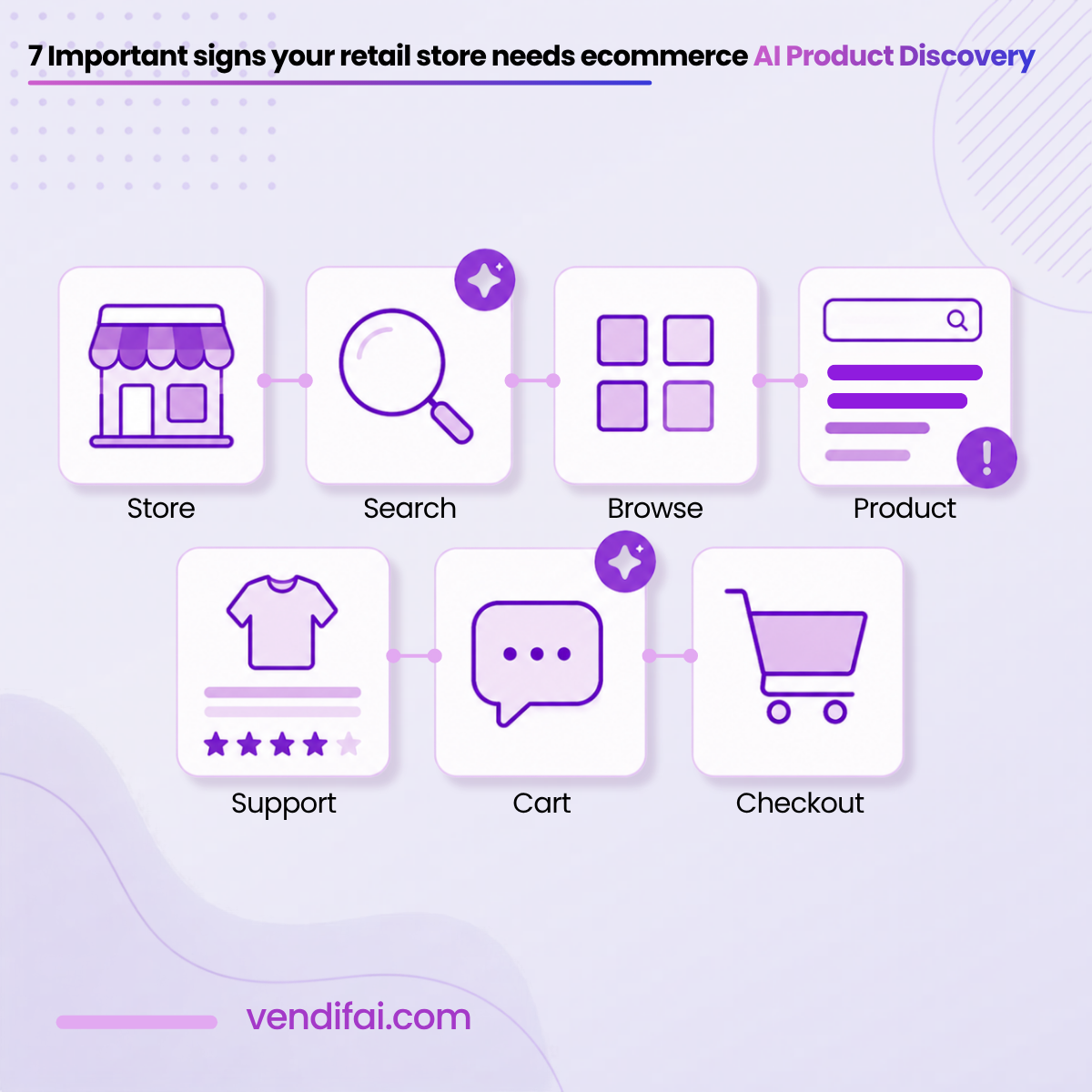
Most ecommerce brands sense something is wrong with their product discovery experience before they can identify it. Shoppers are leaving. Search sessions aren’t converting. Mobile users behave differently than desktop users, but nobody knows why. These issues are not random. They are clear signs that your discovery experience isn’t working. Here are the seven strongest indicators that your store needs ai-powered product discovery.
1. Your search bar returns 'no results found' more often than you think
Pages with no results are the clearest sign of a broken discovery experience. If a shopper searches for something and finds nothing, they won’t try again; they’ll leave. Many retailers are shocked by how high their no-result rate is when they first check out their site to search for analytics. Any rate above 5% is concerned. Rates of 15 to 30% are common with keyword-based search, and each no-result page means a lost sale. What to do: use an ai search solution like VendifAI‘s, which interprets natural language queries. Even vague searches should return relevant results instead of empty pages.
2. You have a high bounce rate on search results pages
If shoppers search, see results, and then leave immediately; the results aren’t matching their intent. High drop-off rates on search result pages indicate a relevance issue, not just a traffic problem. The shopper had a purpose, but your discovery experience failed to meet it. What to do: check which query types lead to the highest exit rates. Natural language queries, long-tail searches, and descriptive queries typically struggle with keyword-based systems. Ecommerce product discovery excels in these areas.
3. Return rates are high, and reviews mention 'not as expected'
When customers say a product “wasn’t what i expected,” they describe a discovery failure. They found a product, but not the right one. The pre-purchase experience did not provide enough information for them to feel confident in their choice. What to do: VendifAI‘s what customers say feature turns raw review content into structured buying guidance, helping shoppers determine if a product fits their needs before they buy. This is a great way to reduce returns without altering your product catalog.
4. Mobile conversion rate lags significantly behind desktop
Mobile shoppers face additional challenges: small screens make filtering difficult, typing precise queries is frustrating, and result pages that require too much scrolling can quickly lose engagement. If your mobile conversion rate is significantly lower than desktop, your discovery experience isn’t optimised for mobile. What to do: voice-based interaction and conversational ai search are much better for mobile than traditional filtering and scrolling. VendifAI allows full voice interaction for product discovery, enabling mobile shoppers to describe their needs naturally.
5. Shoppers browse but don’t buy (high sessions, low conversion)
This is a common sign of a passive discovery experience. Shoppers arrive and explore but do not make purchases. The experience doesn’t guide them from interest to decision; it leaves them to figure it out alone, which most will not do. What to do: the VendifAI shopping companion guides shoppers through their evaluation. It asks smart follow-up questions to narrow down choices, dynamically compares products, and identifies buying intent to prompt action at the right time instead of waiting for shoppers to click the purchase button on their own.
6. You have no visibility into what shoppers are searching for
If you can’t answer, “what did our shoppers search for this week? What percentage found relevant results? you lack meaningful product discovery analytics. Operating without this information makes improvement impossible. What to do: a good ecommerce product discovery platform includes built-in search analytics. VendifAI‘s performance dashboard tracks what shoppers search for, which queries convert, which do not, and where there are gaps in your product catalog or discovery experience.
7. You rely entirely on navigation and category structure
Navigation menus and category trees were created for a time when shoppers understood how your products were organised. Most do not. Depending solely on navigation for product discovery means shoppers who can’t decode your category structure, which is most of them, will get stuck. What to do: ecommerce product discovery adds to your navigation by providing shoppers with a direct, natural language path to what they need. The ask anywhere feature works across your entire site, not just on product pages, so shoppers receive contextual help no matter where they are in the journey.
Checklist: signs you need ecommerce product discovery
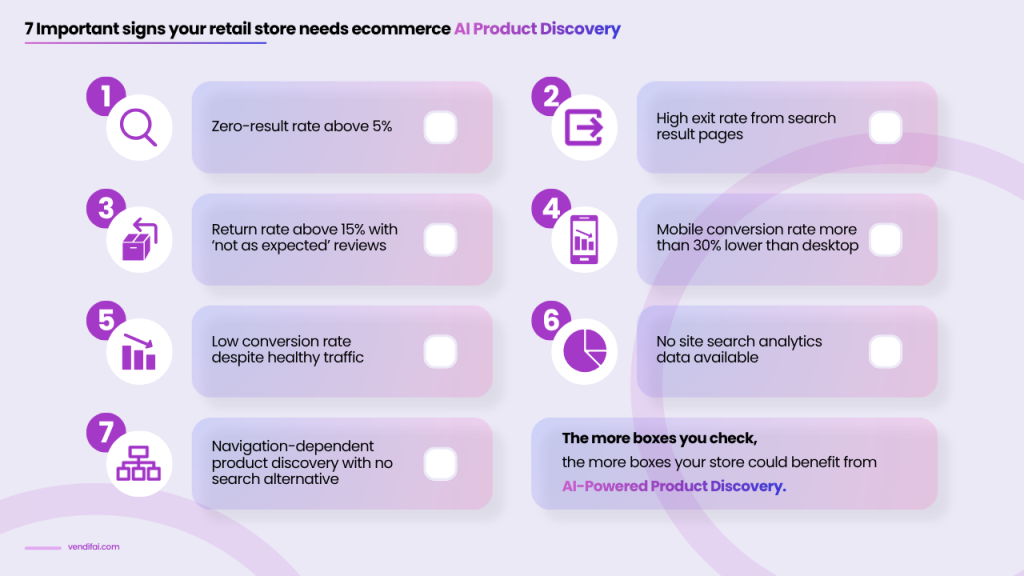
If three or more of these apply to your store, it’s time to consider an ecommerce product discovery solution:
- Zero-result rate above 5%
- High exit rate from search results pages
- Return rate above 15% with ‘not as expected’ reviews
- Mobile conversion rate more than 30% lower than desktop
- Low conversion rate despite healthy traffic
- No site search analytics data available
- Navigation-dependent product discovery with no search alternative
Retail store needs ecommerce product discovery
Frequently Asked Questions (FAQs)
Product discovery optimization is the process of improving how shoppers find relevant products on your site through better search technology, guided selling, and contextual assistance. The goal is to increase conversion rates and reduce abandonment.
Start by checking your zero-result rate and search exit rate. Then replace or enhance your keyword-based search with an ai-powered option that handles natural language queries. Platforms like VendifAI are quick to implement, often in under a day without developer help.
The most common cause is a relevance mismatch; the search results do not align with what the shopper wanted. This is a structural issue with keyword-based search that ecommerce product discovery is specifically designed to address.