
B2B ecommerce product discovery: How AI solves complex catalog search for manufacturers
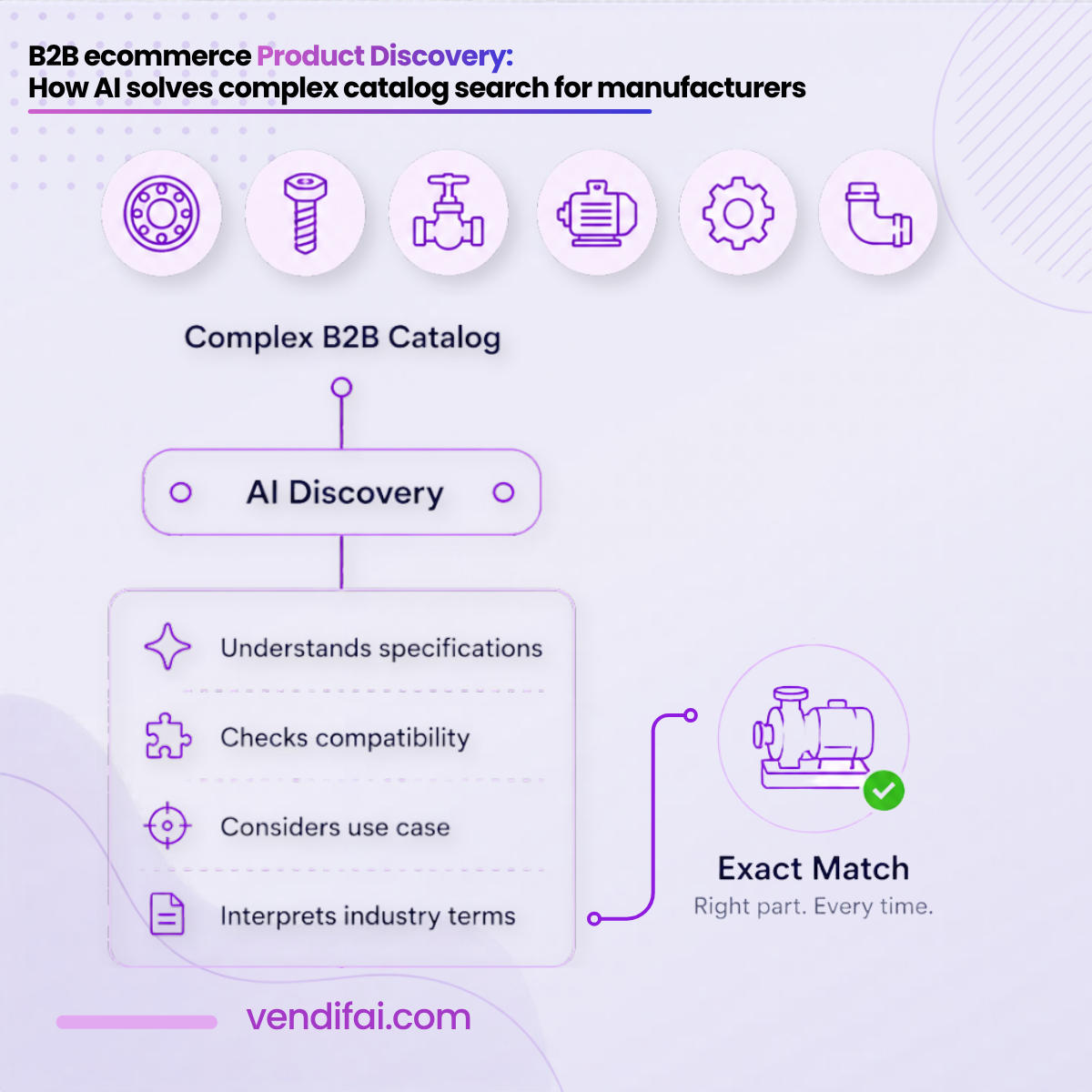
B2B ecommerce faces a unique product discovery issue that differs from consumer retail, and many search tools aren’t built to address it. B2B buyers deal with catalogs that may contain tens of thousands of SKUs. They search using detailed specifications and need to check compatibility across various factors. They lack patience for a search bar that demands exact part numbers for useful results. AI product discovery shifts the dynamics for manufacturers, distributors, and wholesale platforms.
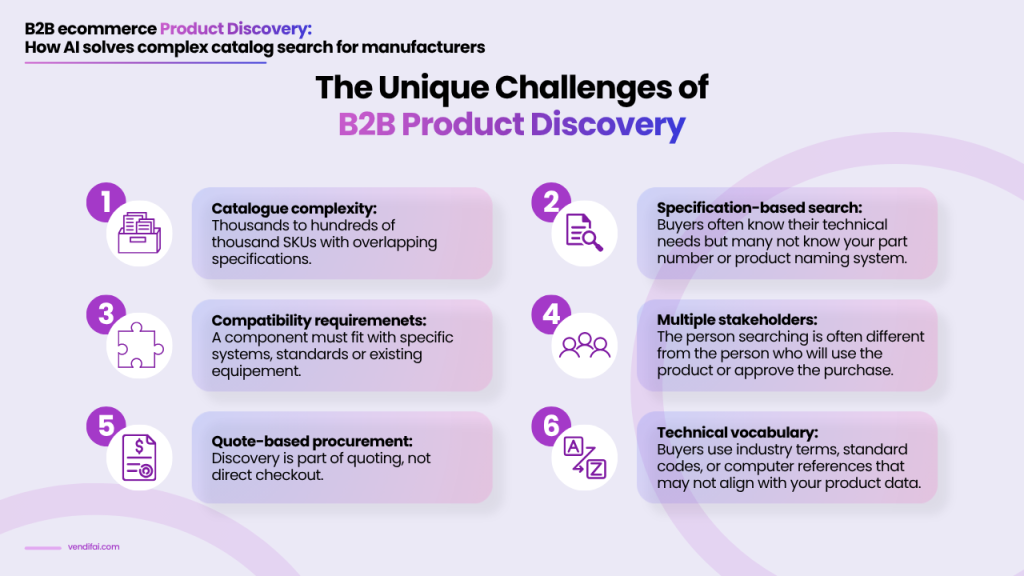
The Unique challenges of B2B product discovery
- Catalogue complexity: thousands to hundreds of thousands of SKUs with overlapping specifications
- Specification-based search: buyers often know their technical needs but may not know your part number or product naming system
- Compatibility requirements: a component must fit with specific systems, standards, or existing equipment
- Multiple stakeholders: the person searching is often different from the person who will use the product or approve the purchase
- Quote-based procurement: discovery is part of quoting, not direct checkout
- Technical vocabulary: buyers use industry terms, standard codes, or competitor references that may not align with your product data
B2B ecommerce product discovery
How AI Product discovery handles complex B2B catalogues
VendifAI’s AI Search engine can process technical specifications described in everyday language, like “a stainless-steel valve compatible with 2-inch pipe, rated to 150 PSI, suitable for outdoor installation.” It returns the right products without needing the buyer to know your SKU naming system. The Shopping Companion can ask smart follow-up questions to confirm compatibility and refine options when specifications are unclear.
The Ask Anywhere feature is especially useful in B2B settings. Buyers on product pages can ask compatibility questions, request specification documents, or confirm if a product meets certain standards. They receive accurate, immediate answers without needing to contact a sales representative.
AI discovery vs traditional B2B catalog navigation
| Discovery task | Traditional B2B search | AI product discovery |
|---|---|---|
| Finding a part by specification | Requires exact product name or part number | Natural language specification search returns correct result | Confirming compatibility | Manual cross-reference or sales call | Ask anywhere confirms compatibility on product page |
| Comparing similar parts | Manual side-by-side in new tabs | Dynamic comparison within shopping companion |
| Cross-referencing competitor part numbers | Not supported | AI Search can handle cross-reference queries if catalogue is configured |
| Bulk ordering with specification variation | Manual SKU lookup per variant | Intent-driven discovery finds variant set matching criteria |
| Time-to-quote | Hours, multiple steps, often requires human assistance | Minutes, AI surfaces correct products, buyer builds quote directly |
B2B buyer journey personalisation at scale
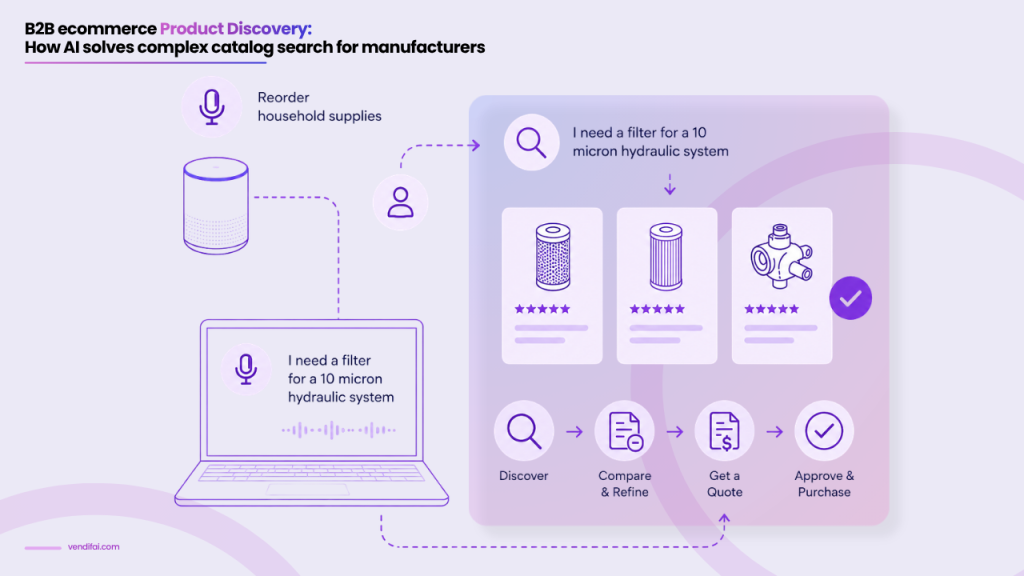
B2B buyers now expect digital experiences similar to those in consumer markets. A procurement manager who can ask Amazon Alexa about household supply orders has no tolerance for a B2B portal that requires knowing a 12-digit part number to locate a replacement part.
VendifAI’s platform delivers a similar, intent-driven, conversational discovery experience. It reduces the mental effort needed for navigating complex catalogs, speeds up the time to quote, and lowers the number of pre-sales support inquiries that can delay the B2B sales cycle.
B2B ecommerce product discovery
Implementation Considerations for B2B
- Ensure product data includes specifications in everyday language alongside formal part numbers
- Set up the AI Product Discovery with B2B-focused follow-up questions: application, industry, compatibility standards
- Connect the performance dashboard with your CRM to monitor how AI product discovery affects pipeline and quote speed
Frequently asked questions (FAQs)
It enables natural language specification searches across complex catalogs, confirms compatibility through conversational follow-ups, reduces time to quote, and provides relevant product information through Ask Anywhere, all without expecting buyers to know exact part numbers or SKU codes.
Yes, as long as the product catalog includes sufficient specification data. AI Search processes technical descriptions in plain language, matching buyer requirements to catalog entries even when the wording differs.
By allowing buyers to navigate complex catalogs, ask compatibility questions, find the right variants, and compare specifications on their own, without contacting a sales representative. This decreases the volume of support requests and accelerates the buyer’s journey toward getting a quote.